



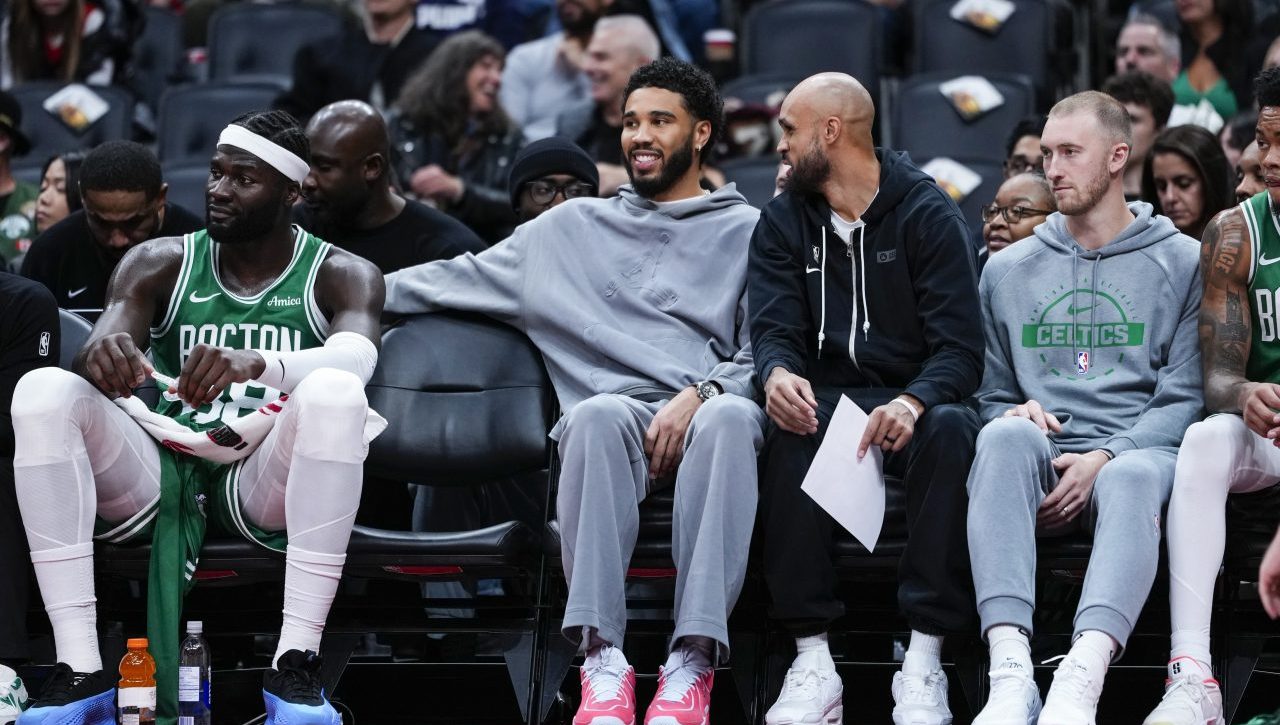

The first 54 games of the Boston Celtics’ 2025-26 season were an overwhelming success. Boston arrived at the All-Star break sitting 16 games over .500 while owning the second-best record in the Eastern Conference and the third-best net rating in the league.
So many of the questions that hovered around an overhauled roster entering the season have already been answered. Jaylen Brown hasn’t just thrived in the 1A role, he’s muscled his way into the MVP conversation. Big man Neemias Queta has the seventh-best net rating in the league (+11.6) after elevating to a starting role with a new-look center depth chart.
Joe Mazzulla scoffed at all the gap year suggestions and deserves Coach of the Year consideration for the way he’s pushed all the right buttons, particularly in how he’s dispatched role players on a team that’s far deeper than most anticipated after some painful summer alterations.
All of this while the Celtics prep for the potential in-season return of All-NBA forward Jayson Tatum.
Which, of course, headlines Boston’s potential post-All-Star to-do list. Despite all the success, there are a bunch of checklist items for the Celtics to navigate over the final 28 games of the season and before the playoffs arrive. That list includes:
1. The reintegration of Jayson Tatum
The Celtics could (very) soon have the very best sort of problem. Tatum is now nine months removed from Achilles surgery and seems to be ticking the final boxes on his own rehab checklist. His potential return would force the Celtics to shuffle their rotation a bit, particularly as he ramps himself back up at the start of his return.
But even Tatum at, say, 75 percent of his peak powers will be an impact presence. His rebounding and defensive versatility will further shore up areas in which the Celtics have already made tremendous strides in since the start of the season. The No. 2-ranked offense in the NBA will add one of the game’s elite scorers, as well as a player that’s been top six in MVP voting in each of the past four seasons.
In much the same way that the Celtics had to figure out how to thrive in Tatum’s absence, they must now figure out how to morph when he returns. There will be obvious rust for Tatum. Things could occasionally look clunky for the Celtics as usage rates are redefined. There are a handful of new faces that Tatum has never played with. And yet the core of this team remains largely intact, and that group has thrived on the biggest stages. We don’t suspect it’ll take long for the Celtics to figure out how this collection works best with Tatum again.
Tatum’s presence alone ought to improve the shot qualities for players like Derrick White and Payton Pritchard, who have encountered more attention in his absence. Imagine what Brown will be capable of when teams can’t load up on him to the level he’s seen without Tatum.
Despite Tatum’s very self-aware trepidation about not wanting to rock the boat upon his return, the best and most championship-worthy version of the Celtics features him on the court. His return gives an already thriving Celtics team a legitimate chance to contend for a title.
2. Filling out the roster
After working diligently to get out of the luxury tax at the trade deadline, president of basketball operations Brad Stevens will (slowly) fill out the end of the roster before the end of the regular season.
The Celtics, lingering just south of the tax line, must navigate a delicate series of roster moves that is likely to start with elevating rookie two-way players and, eventually, culminate with rostering at least one player of longer service. Each day matters given Boston’s financial constraints, but the Celtics will (slowly) get back to the league-mandated 14 roster players.
As for buyout pursuits, especially those players waived before the March 1 playoff-eligibility deadline, the Celtics can only window shop for now. But keep in mind that the Celtics already have too many bodies for available minutes, and that’s before Tatum even hits the floor.
3. Figuring out the playoff rotation
When the playoffs arrive, it seems fair to suggest that Tatum, Brown, White, Pritchard, Queta, Sam Hauser, and newcomer Nikola Vucevic are going to see the majority of minutes. Mazzulla must determine how to deploy that talent, and that includes continuing to integrate Vucevic after his acquisition. The team got immediate returns in shuffling Pritchard back to the bench, and we’re intrigued to see what becomes of the team’s end-of-game lineups.
The real question might simply be which of Boston’s young wings will emerge as consistent postseason presences. Jordan Walsh, Baylor Scheierman, and Hugo Gonzalez have each gotten long auditions (and departed Josh Minott did as well earlier in the year, while two-way wing Ron Harper Jr. has provided strong minutes in recent opportunities).
Scheierman has clearly won Mazzulla’s trust, as emphasized by starting four of the five games before the All-Star break. His blend of defensive versatility and 3-point shot-making has been accentuated in bigger minutes. Jordan Walsh had a stretch earlier this season where his defense and energy had opponents raving about his potential, and he tapped into that energy in the first-half finale against the Bulls on Wednesday. Gonzalez has the best net rating (+17.0) among all players with 40+ appearances this season and brings a positive chaos each time he touches the floor.
Players have thrived in Mazzulla’s “ready when called upon” strategy, and maybe that’s how it will remain into the postseason. But that each of those young wings can make a strong case for minutes emphasizes again just how good and how deep this group has been.
4. Planting seeds
The Celtics figuring out the best version of themselves ought to be the priority over the final 28 games, but despite all the laments about the state of the East, seeding could be important to how the postseason plays out.
The Celtics enter the break with a half-game lead on the Knicks, while the James Harden addition has helped Cleveland surge to within 1.5 games of Boston. The jockeying for the No. 2 seed could be a featured storyline down the stretch.
Securing the No. 2 seed ensures a play-in opponent in Round 1, delivers home court in Round 2, and helps avoid the top seed until the conference finals. What’s more, having home court in, say, a 2-3 matchup versus either New York or Cleveland, could be very beneficial given the challenges those teams pose.
The Celtics play the Cavaliers and Knicks — both on the road — one more time over the final two months of the regular season. Those games could very well impact the final seedings in the East, or at least provide playoff-like environments in the ramp to the second season.
5. Heavy lifting over the final 28
The Celtics have the fifth-hardest remaining schedule, and the second-most challenging in the East behind only the Bulls (who have seemingly traded in their yearly play-in fast pass for a much-needed lottery pursuit).
What’s more, Boston’s final 28 games …
- Starts with a daunting four-game road trip out West, including a potentially emotional start while going up against an Al Horford/Kristaps Porzingis combo in Golden State. That trip ends with a back-to-back against Nikola Jokic and the Nuggets.
- Features two matchups with the defending NBA champion Oklahoma City Thunder.
- Includes a trek to play Wemby and the Spurs in a gauntlet trip in mid-March that takes Boston from Cleveland to San Antonio to Oklahoma City.
- Features the potential Horford/Porzingis homecoming when Golden State visits TD Garden on March 18.
Needless to say, March, with only one two-day break in the entire month, could be filled with storylines and quality games.
Rest up at the All-Star break. The Celtics have enjoyed a lot of success to this point, but the final 34 percent of the regular season ought to bring a whole bunch of intrigue as well.


