



We’re still one week away from the 2026 MLB trade deadline, but Boston Red Sox chief baseball officer Craig Breslow got an early start with a noteworthy move over the weekend.
On Saturday night, the Red Sox traded rookie left-hander Connelly Early to the Washington Nationals in exchange for infielder Curtis Mead. Breslow addressed the deal on Sunday.
“I think this move makes our major league roster better,” Breslow said. “That’s not to diminish Connelly Early and what I think he’s capable of… but what our roster needed right now, we thought was someone who could hit at the top of the order, the middle of the order… we think he makes us better in the short-term and in the long-term.”
Unsurprisingly, the deal sparked some negative reactions among Sox fans who have grown fond of Early over the last year. The 24-year-old earned a spot on the MLB roster last September after dominating the Double-A and Triple-A levels. He immediately impressed for the big-league club, posting a 2.33 ERA across four starts before taking the loss in Game 3 of the Wild Card Series against the New York Yankees.
This year, Early posted a 3.44 ERA and 1.255 WHIP across 17 starts before going on the injured list with elbow inflammation. He hasn’t pitched since June 30, and there’s still no timeline for his return to the mound.
Still, on the surface, trading Early for a little-known infielder who the Chicago White Sox designated for assignment four months ago seems like a massive overpay. We’re here to tell you that it wasn’t. In fact, it was a smart move to bolster the lineup with a young, high-upside bat who’s under team control for the next several years.
Here’s why the move makes sense for Boston:
Late bloomer
In 2023, MLB Pipeline ranked Mead as the No. 31 prospect in baseball and the No. 2 prospect in the Tampa Bay Rays system — ahead of Tampa’s All-Star slugger Junior Caminero. Mead failed to find his footing in the majors with the Rays, who shipped him to the Chicago White Sox at last year’s deadline.
Mead’s struggles continued with the White Sox, resulting in him being DFA’d last March. The Nationals acquired him via trade and reaped the benefits over the next few months.
With Washington, Mead unlocked his potential at the plate with 17 doubles, 17 homers and 48 RBI in 87 games. The 25-year-old posted a .254/.352/.500 slash line, giving him an .852 OPS that ranks second on Boston’s roster behind only Willson Contreras.
Sure, regression to the mean is possible, and that’s the obvious risk that comes with this type of deal, but it’s just as likely that Mead has rediscovered what made him one of MLB’s most exciting prospects just three years ago. If that’s the case, the trade will go down as a no-doubt home run.
Under the hood
A look at Mead’s underlying metrics should get Red Sox fans excited about getting his bat into the lineup.
Mead ranks in the 84th percentile in xwOBA (expected weighted On-Base Average), which measures the true quality of a hitter’s contact rather than relying on luck or defensive plays. The advanced stat is formulated using exit velocity, launch angle, and, on certain types of batted balls, sprint speed.
Also encouraging is that Mead doesn’t often chase pitches out of the zone (78th percentile), and he walks almost as often as he strikes out. He has K’d 62 times with 39 walks in 327 plate appearances this season.
Mead doesn’t hit the ball all that hard (29th percentile average exit velocity), but he barrels balls at a 10.9 percent clip (69th percentile).
Tailor-made for Fenway
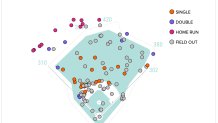
Breslow has an affinity for right-handed hitters who pull the ball in the air at a high rate. That approach makes sense, considering that giant green wall in left field at Fenway Park.
Knowing that, it should come as no surprise that Breslow salivated over the opportunity to add Mead to the lineup. He ranks near the top of the entire league in Pull-AIR% (22.5), and his Fenway spray chart shows how much damage he could inflict at his home ballpark:

Here to stay
We’d be singing a different tune about the trade if Mead was only under contract for one or two more seasons, but he’s locked in to a team-friendly contract for the long haul. He’s still in his pre-arbitration years and won’t become a free agent until after the 2030 season.
The bottom line
It’s sad to see Early go. He has a bright MLB future and should be a fixture in Washington’s rotation for years to come. That said, in any move to improve Boston’s lineup this summer, Early always seemed like the odd man out.
The Red Sox are flush with left-handed pitching talent. One could argue Early was the fifth-best left-handed starter on Boston’s depth chart behind Garrett Crochet, Ranger Suarez, Payton Tolle, and Jake Bennett. Add in Early’s elbow injury and his alarming number of homers allowed this season (15 in 17 starts), and it’s no surprise that Breslow decided it was time to move on.
This deal makes perfect sense for both sides. The Nationals get a much-needed rotation upgrade, while the Red Sox bolster an offense that has ranked near the bottom of the league in virtually every major category this season. Both clubs get high-upside players who are under team control for the next half-decade.
Perhaps Boston could have included Early in a trade package for a premier slugger, but there aren’t many enticing, realistic options out there. And if the options were Early-for-Mead or Early and a prospect haul for someone like Los Angeles Angels shortstop Zach Neto, we’re taking the Early-for-Mead side.
Mead is no sure thing, but parting ways with pitching depth in an effort to upgrade the offense is certainly a risk that was worth taking.


