



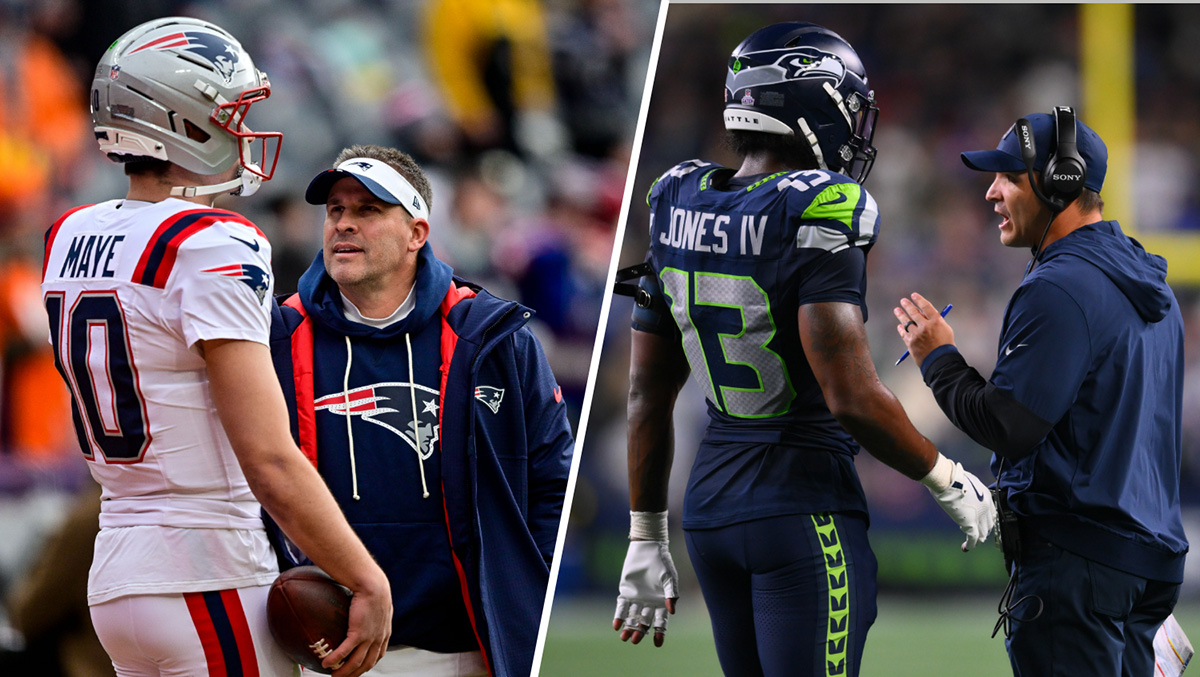

SANTA CLARA, Calif. — Patriots quarterbacks coach Ashton Grant rolled his eyes, anticipating the question before it even breezed past a reporter’s lips.
“You’re not,” he said, “going to say Cover 6.”
In the days leading up to Super Bowl 60, as more and more wondered about the nuances of the game plans they’ll see from the Patriots and Seahawks, there was a potential blueprint laid out by Xs and Os lovers for Seattle against MVP runner-up Drake Maye: Cover 6.
It’s a coverage that deploys three defensive backs deep, with one side of the field split into quarters manned by a safety and a corner. The other side of the field, meanwhile, features a safety patrolling the deep half of the field to his side with a corner underneath covering the flat.
The numbers for Maye against that particular coverage represent a drop-off in production relative to his performance against just about every other defensive look. Per Sharp Football, against Cover 6, he ranked 31st among 36 qualifying quarterbacks in EPA, 32nd in yards per attempt and 33rd in success rate this season on over 60 dropbacks.
The Bills deployed Cover 6 in the second half of their win in Foxboro in Week 15 when they shut out the Patriots over the final two quarters. The Ravens trotted it out more than usual against Maye soon thereafter. And in the postseason, the Patriots have continued to see that look as their quarterback has grinded his way through a low-scoring trio of playoff games.
“I think it’s become a thing in the league more and more the past couple of years to play quarter-quarter-half,” Maye said. “Whether it’s something that they cloud the boundary (as the Cover 2 side), they cloud the field, it’s kinda depending on what the team does.
“The challenge is, they try to stay (with) two high (safeties), they take away deep shots, but also you got chances underneath. There’s holes in every coverage. Knowing that, and just trying to exploit where we can. Knowing that we got guys out there that have great feel in zone and can find the zones and try to sit down. And also we gotta be able to run the football.”
The Seahawks deploy plenty of two-high safety looks — including Cover 6 — with head coach Mike Macdonald calling the shots. Identifying which two-high coverage he’s chosen, though, is a challenge, because his defense is able to disguise its intentions until after the ball is snapped.
“I think, Mike, he’s as good of a coach at coaching this as we played,” offensive coordinator Josh McDaniels said. “And we’ve played a lot of good coaches that try to hold the disguise, but if you watch, if we have the ball for 70 snaps in the game, 65 of them are gonna look the same before the ball’s snapped. which is a unique trait for them, and a big challenge for us.
“The biggest thing we’ve talked to our guys about is, well, you gotta confirm it once the ball is snapped. You can’t make any decisions before the ball’s been snapped as a quarterback, because if you do, there’s a good chance you’re gonna be wrong.
“It just jumps off the film when you watch them, you pause it, and the ball hasn’t been snapped. It’s like, ‘Okay, it looks the same… looks the same… Then two seconds after the ball’s been snapped, if they’re rotating, they rotate late, they drop down late, they spin the coverage, whatever it is, or they stay there, and then they make you decide, all right, is this quarters on this side? Is it Cover 2?”
McDaniels earned himself the AP’s Assistant Coach of the Year Award in part by teaching Maye — who did not play in a pro style offense in college and then worked in a West Coast system as a rookie — to read coverages the way he’s asked all his quarterbacks to read coverages going back to Tom Brady.
But reading Macdonald’s defense is like thumbing through a Stephen King novel. You’ve got an idea that something hair-raising is headed your way, but you’re not exactly sure what.
“That,” McDaniels said, “would be a game within the game, for sure.”
How Maye handles Macdonald’s coverages will be critical. The Cover 6 storyline, however, may be a bit overblown. That’s at least according to Grant. He explained that the team won’t necessarily do a deep dive on Maye’s performance against certain coverages until after the season. And he cautioned against buying into efficiency stats with somewhat of a small sample.
“Every play has a life of its own, and there’s context behind every play,” Grant explained.
“Every turnover is not the same. So, that’s why it’s hard for me to sit and look at EPA or DVOA without watching the tape.
“… These guys make fun of me, ’cause I’m on my phone a lot. And I’m on Twitter, because I’m searching for as much information as I can find about opponents, about anything that shows up. The way the algorithm on my ‘X’ is built right now is like all Patriots stuff and all bulletin board material, if I want to use it. So, the Cover 6 stuff has just shown up over and over.”
NBC Sports Boston analyst and former Patriots quarterback Brian Hoyer noted on a recent episode of Tom Curran’s Patriots Talk Podcast that Maye threw a tipped-ball interception and a third-and-forever “arm punt” pick against Buffalo’s Cover 6 that helped tank his EPA and quarterback rating against that specific coverage.
“You’re cherry-picking these negative plays, where I would say they’re not that big of a deal,” Hoyer said. “I would say too, going into this game, [McDaniels] understands that that’s part of what the Seattle Seahawks do so he’s going to build in some plays that attack quarter-quarter-half.”
According to NextGen Stats, the Seahawks play Cover 6 at the second-highest rate in the NFL, just over a fifth of the time (22 percent). If Maye is going to puncture that look in the biggest game of his life, he’s going to have to read it correctly and then attack.
Aggressively.
“He has to be himself,” McDaniels said. “You can’t go play in this game and try to do something that’s really not in your comfort zone. Then he has to take care of the football and be aggressive at the same time. There’s no fine line on that. It’s just, it is what it is.
“I don’t know how many Super Bowls I’ve coached in where we didn’t turn the ball over at some point. You’ve just got to keep going. It doesn’t mean that you’re gun shy the next time you get the ball. It is what it is. If something happens, you just got to keep playing. Because we’re not going to be able to win this game just kneeling on the ball. That’s not going to happen.”
Here are the matchups we’ve got our eyes on in Super Bowl 60…
Matchup that will determine the outcome
Drake Maye vs. Mike Macdonald
Even if Maye doesn’t rediscover his MVP-caliber form, if he wants to beat the latest in a line of great defenses he’s had to see this postseason, he’ll have to make a handful of high-level throws. Take, for instance, the Divisional Round win over the Texans. His three touchdown passes that day were all high-degree-of-difficulty throws that required some quick post-snap processing from the 23-year-old.
Grant told me there was one Week 7 snap earlier this season, against the Titans, when he realized the Patriots had a high-level in-game thinker on their hands.
“One specific play that comes to mind is, we hit a shot to Mack Hollins down the sideline versus Tennessee, and it was some type of designer Cover 2, where it ended up playing out like 2-Tampa, but pre-snap, it didn’t look like 2-Tampa.
“They spun the coverage on him, and he was able to hit a hole shot over the corner. He’s been able to do things like that since we got here in OTAs and training camp, and I think he does a good job recognizing things post-snap. But that would be one moment where I was like, ‘OK, if he’s seeing this…’ “
Short throws to the flats to Rhamondre Stevenson, horizontal routes to short-area wiz Stefon Diggs, or deep crossing routes — if the Patriots can hold the quarters-side safety with some underneath bait and then send a longer route over the top from across the field — all could be options for Maye against Macdonald’s two-high looks.
But Maye has been a fan of the “hole shot” against Cover 2, like the play Grant highlighted, whenever he sees that opening. If he can find Hollins or Kayshon Boutte between the Cover 2 safety and corner along the sideline for an explosive gain — in a game that could be low-scoring — that kind of play could swing the outcome.
Matchup that will surprise you
Zak Kuhr’s blitzes vs. Sam Darnold
Get ready for some haymakers to be thrown when the Seahawks offense has the football.
The Patriots have become more blitz-happy this postseason, sending extra rushers on 38.3 percent of opponent dropbacks, and they’ll be facing a quarterback in Darnold who threw more interceptions against the blitz in the regular season than anyone (seven). His rating against the blitz in the regular season was 93.6, ranking 22nd in the NFL, and his EPA per dropback was 0.08.
Against the Vikings in Week 13, Darnold was blitzed on over 60 percent of his dropbacks by former Patriots play-caller and Minnesota defensive play-caller Brian Flores, and he posted one of his worst statistical lines of the season.
In the postseason, however, Darnold has been far better against blitzing defenses, with a 123.6 rating on 18 blitzed attempts and an EPA per dropback figure of 0.33.
Even if the Seahawks occasionally catch the blitzing Patriots for an explosive play, will Kuhr continue to try to heat up Darnold? In the regular season, he ranked 28th in EPA per play under pressure. Blitzes that are timed well against a heavy play-action passing team like Seattle can lead to some momentum-shifting pressures.
Two areas to watch when Kuhr dials up pressure Sunday:
1) Do New England’s blitzes force Kenneth Walker III into pass-protection in order to prevent against quick pressure?
Among 44 backs with at least 45 pass-blocking snaps this season, Walker III ranks 36th in Pro Football Focus’ pass-blocking grade. He also sports a pass-block percentage of just 9.1, which is 43rd among the group, indicating that offensive coordinator Klint Kubiak would prefer not to have Walker III in protection as part of his plan to keep Darnold upright.
2) If the Patriots are short bodies in coverage after devoting extra rushers to the line of scrimmage, will they play man or zone behind their blitzes?
A man-blitz approach could force Christian Gonzalez into some 1-on-1 coverage situations with First-Team All-Pro wideout Jaxon Smith-Njigba — a strength-on-strength battle that could be worth the price of admission.
Matchup that will make your Sunday
Patriots defensive tackles vs. Seahawks interior linemen
Building off that thought that the Patriots might try to blitz Darnold to kingdom come, might those pressure packages allow Milton Williams or Christian Barmore to get matched up with Seattle right guard Anthony Bradford 1-on-1?
We laid out why those 1-on-1 moments with Bradford could change the game here. This feels like an area of the game the Patriots will have to dominate if they want to hoist the Lombardi Trophy. Mike Vrabel dropped a well-worn line in the Divisional Round win over the Texans, insisting that, “The big dogs come out in January.”
He’s going to need them to be on the loose in early February, too.
Matchup that could ruin your Sunday
Seahawks defensive front vs. Patriots rushing attack
The Seahawks have dared opposing offenses to run on them all season. And they simply continue to dominate when quarterbacks turn to hand off.
Oftentimes with just four two-gapping defensive linemen — former Patriots offensive line coach Dante Scarnecchia gave us a breakdown on how to thwart their one-knee approach to two-gapping on a recent episode of Next Pats — Seattle turned itself into the best run defense in football this season from an EPA per play standpoint.
Leonard Williams, Byron Murphy II and DeMarcus Lawrence are among the best in football at stopping the run, and their depth chart on the edge is deep enough to keep those players fresh on early downs.
The Seahawks did get run on in the NFC title game, though. How? Sean McVay’s zone runs did real damage, picking up a whopping 0.17 EPA per play, per Sports Info Solutions — which, for context, far exceeded the No. 1 EPA per play rushing figure in football this year (Chicago, 0.10).
The Patriots, though, ran the second-fewest zone attempts in football this season, per SIS (130). That has continued into the postseason as the Patriots have been much more of a “gap run” team (58 attempts) than a zone team (six) in their last three games.
Patriots running back Rhamondre Stevenson said this week that he’s “super confident” in what his offensive line can do with its gap runs (4.0 yards per carry in the playoffs). Finding room behind the double-teams of right guard Mike Onwenu and right tackle Morgan Moses has been particularly enjoyable, he said, highlighting his years of experience with Onwenu.
But the Seahawks will have a say in just how much fun the Patriots have running the football at Levi’s Stadium. Against gap runs this season, they were second in the NFL in yards per attempt allowed (3.4) and EPA per play (-0.21).
If the Patriots can’t move the football on the ground against Macdonald’s four-man fronts, that would allow them to stick with their two-high safety shells, making the deep passing game — one of Maye’s strengths this season — even more challenging.
As one NFC offensive coordinator put it recently, when Seattle’s run defense is working the way it has worked this season, “You can’t push it down the field, you can’t hold it, and you can’t run it.”
Prediction
Patriots 20, Seahawks 17

