



It’s been a rough couple of months to be a Celtics fan.
Boston fumbled away a 3-1 lead in Round 1 against Philadelphia, spoiling what had otherwise been a highly enjoyable 2025-26 season. The Knicks won a championship and haven’t stopped parading around in the aftermath. The Celtics traded former Finals MVP Jaylen Brown to a division rival, and those Sixers signed LeBron James in the aftermath to create a potential super team. The East as a whole looks as good on paper as it has in decades.
The duck boats that flowed through downtown Boston just two years ago now feels like two lifetimes ago.
You’ve got two choices, though. You can sit here and wallow in self-pity. Or you can accept that what’s done is done, and move on. We all ran the emotional gamut and navigated the stages of grief that are inevitable when trading a franchise pillar. Some got through it quicker than others. Now it’s time to shift the focus from what happened to what comes next.
This is us channeling our inner Veronica Vaughn. We’re dragging any Billy Madison-looking Celtics fans into the pool and trying to roust you from July’s pity party. I believe in you, Billy (Chisholm). And Brad, too.
Here are four reasons to be optimistic about what comes next for the Celtics:
MVP season loading?
Roster construction and money allocation in the apron era played a major role in Boston’s decision to pivot away from Brown, but we thought it was telling that when Celtics president of basketball operations Brad Stevens discussed the trade, he almost immediately pointed to having such a high percentage of usage tied up in two superstars.
Brown finished 36.1 percent of Boston’s possessions during his floor time last season. That wasn’t just a career high, it was the 18th-highest single-season mark in NBA history since usage tracking began in 1978, per Basketball Reference. It was the highest mark in Celtics history and well north of the previous top usage rate set by Isaiah Thomas (33.8 percent) during his magical 2016-17 season.
Maybe Brown would have happily downshifted his usage with a healthier Jayson Tatum on the court this season. Maybe the advanced metrics that showed Boston performed better with Brown off the court in each of the last four seasons would have stabilized. But the Celtics evidently weren’t waiting to find out.
What’s clear now, while the team plots the next iteration of its roster, is that Tatum is going to shoulder the offensive load for the 2026-27 season and probably beyond. If the Celtics were to outkick the downsized expectations amid the departure of Brown, then Tatum is going to thrust himself directly into the same MVP conversation that Brown lingered in last season.

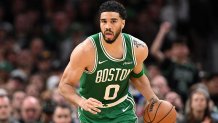
Brian Fluharty-Imagn Images
Brian Fluharty-Imagn Images Jayson Tatum could be in for a huge 2026-27 season as the sole focal point of the Celtics offense.
This will be the first time that Tatum has been the sole focal point of the Celtics’ offense. There will be instances where he needs to use that attention to create opportunities for teammates. But Tatum is going to finish a lot of possessions. And his stat line could soar because of it.
Tatum already owns the Celtics’ record for single-season scoring average from the 2022-23 season, when he averaged 30.1 points to go along with 8.8 rebounds and 4.6 assists over 36.9 minutes per game. He finished fourth in MVP voting that year.
Tatum’s rebounding was off the charts after his return last season (10 rebounds per game in 16 regular-season appearances). He’s averaged a career-best 8.2 assists per 100 possessions in each of his last two seasons. It’s not hard to imagine a particularly glitzy stat line next season.
In much the same way that Brown thrived as the focal point last year and earned heavy MVP chatter when Boston bested outsider expectations, it feels like Tatum will have the chance to do the same this year. Maybe Victor Wembanyama will simply have a stranglehold on the award moving forward — with Nikola Jokic and Shai Gilgeous-Alexander unlikely to cede their spots at the top of balloting as well. But Tatum will be in the conversation with plenty of possessions available to state his case.
In a big country
Overshadowed by all the Brown drama, the Celtics shored up maybe their biggest area of need last season by signing center Mitchell Robinson. It also created a void for a primary rival by signing away the Knicks’ longest-tenured player and a key piece of their championship bench.
Robinson is a glass-cleaning, country music-loving machine who will turn a whole bunch of Boston’s missed 3-pointers into the second-chance opportunities that Joe Mazzulla so dearly covets. Robinson corralled 21.2 percent of his team’s missed shots last season. That wasn’t just the highest mark in the NBA, it was nearly six percent higher than the next closest player with 1,000+ minutes played (Donovan Clingan, 15.3 percent).
The Celtics know full well how valuable Robinson can be. Mazzulla routinely deployed a Hack-a-Mitch strategy in hopes that New York would take Robinson off the court due to his free-throw woes. Opposing teams will do the same against Boston this year, but Robinson’s impact is undeniable if he stays on the court.
Chris Forsberg shares his take on the Celtics signing Mitchell Robinson and why he likes the move.
The Knicks’ offensive rebound rate spiked by 9.8 percent per 100 possessions during Mitchell’s floor time last season. He corralled 31.9 percent of his own misses. His kickouts created some of the most efficient looks that New York got last season.
Can Robinson stay on the floor — both in terms of health and teams targeting his free-throw shooting weakness? That’s a major question for a player who averaged just 19.6 minutes per game over 60 appearances last season, and missed 116 games over the previous two campaigns.
But his ability to impact winning when he’s on the court is undeniable. He’ll add much-needed depth to a spot that got exposed as Boston fumbled away that 3-1 series lead against the Sixers. His impact could greatly outkick the 9.1 percent of the cap he signed for while inking a 3-year, $47 million deal with Boston.
Kick the player development team into overdrive
Maybe the biggest storyline from last season was the way many of Boston’s youngest players thrived in elevated roles. From Neemias Queta and Payton Pritchard shuffling into starter spots, to recent draftees like Baylor Scheierman, Hugo Gonzalez, and Jordan Walsh all thriving in elevated minutes at various points throughout the 2025-26 campaign, to Luka Garza carving out a role after barely playing at two previous stops, it’s clear the Celtics can maximize their young talent.
Now all those players need to make another leap — or at least find the sort of consistency that the best players in the league bring on a night-to-night basis.
Sure, it would help if Derrick White finds his shot after a rough offensive season. But Pritchard will get every opportunity to be the No. 2 scoring option on the team. Can he eliminate some of the variance in his output, especially when the 3-point shot defies him? His numbers when sharing the floor with Tatum are particularly intriguing.
Can Neemias Queta avoid the sort of foul trouble that forced him off the court too often in the postseason? How many of Boston’s wings will make the sort of leap that makes it easy for Mazzulla to pencil them in for heightened minutes each night?
One thing that could help: The addition of veteran point guard Mike Conley. While Conley’s on-court role might be limited in his age-39 season, he brings 37,588 minutes of regular-season experience. He’s played in 120 playoff games.
To put it another way: Celtics rookie Chris Cenac Jr. was four months old when Conley Jr. was drafted in June 2007. His ability to guide young players could certainly aid Boston’s young nucleus.
The Celtics need to continue to nurture and develop from within.
In Brad We Trust: Optionality and clean books
Look, no one is going to hang a banner for resetting repeater penalties. Or creating optionality. But navigating the second apron and creating windows for increased spending certainly matters in this new apron era. The Celtics are putting themselves in a position to be opportunistic while much of the league is steamrolling towards a reckoning that Boston has already started navigating.
Stevens talked a lot about that optionality in the aftermath of the Brown trade. It’s not fun having to wait for the next shoe to drop, but all the pain points the Celtics have endured the past two summers — from the departures of core championship pieces like Kristaps Porzingis, Al Horford, Jrue Holiday, and Luke Kornet last year; to the shocking Brown trade — have positioned the team to be aggressive with roster construction moving forward.
The next disgruntled NBA star is only a news cycle away. Maybe Denver implodes under the weight of the second apron. Is Anthony Edwards going to stay happy in Minnesota with LaMelo Ball added to the mix? Stars get moved every season, and yet we never stop being surprised when it happens.
The Boston Celtics have officially traded Jaylen Brown to the Philadelphia 76ers for Paul George and draft picks. In a stunning press conference, President of Basketball Operations Brad Stevens and lead owner Bill Chisholm addressed the media to defend the blockbuster move, citing “future optionality” and roster depth. Our Early Edition crew gives their reaction to the trade details, the press conference, and what this means for Jayson Tatum and the Celtics’ championship window moving forward.
The Celtics have the parts to at least get in on the conversation for any players that become available. The team can be judicious in hunting the next star it yearns to pair with Tatum. Maybe the team prioritizes depth and tries to find high-value players on mid-tier salaries to put around Tatum.
Stevens has quietly been locking up depth pieces on team-friendly deals. Queta (four years, $60 million) got a big extension, and Pritchard could soon sign a three-year, $67 million extension. The Celtics inked both Ron Harper Jr. and Jordan Walsh to long-term deals. Neither that duo, nor recent draftees Baylor Scheierman and Hugo Gonzalez will earn more than 3 percent of the cap through their current pacts.
The Celtics need to maximize their optionality. They need to be willing to spend when free of the repeater shackles next summer. But they’ve created more pathways than previously existed through their often painful maneuvering over the past two summers.
Stevens has thrust himself into a harsh spotlight by trading Brown. There’s going to be pressure to hit a home run on whatever big move comes next. Patience is in short supply in these parts. But Stevens has to show that the Brown trade, painful as it was, was a necessary step in getting the Celtics back to a spot where they can truly compete for a title.

