



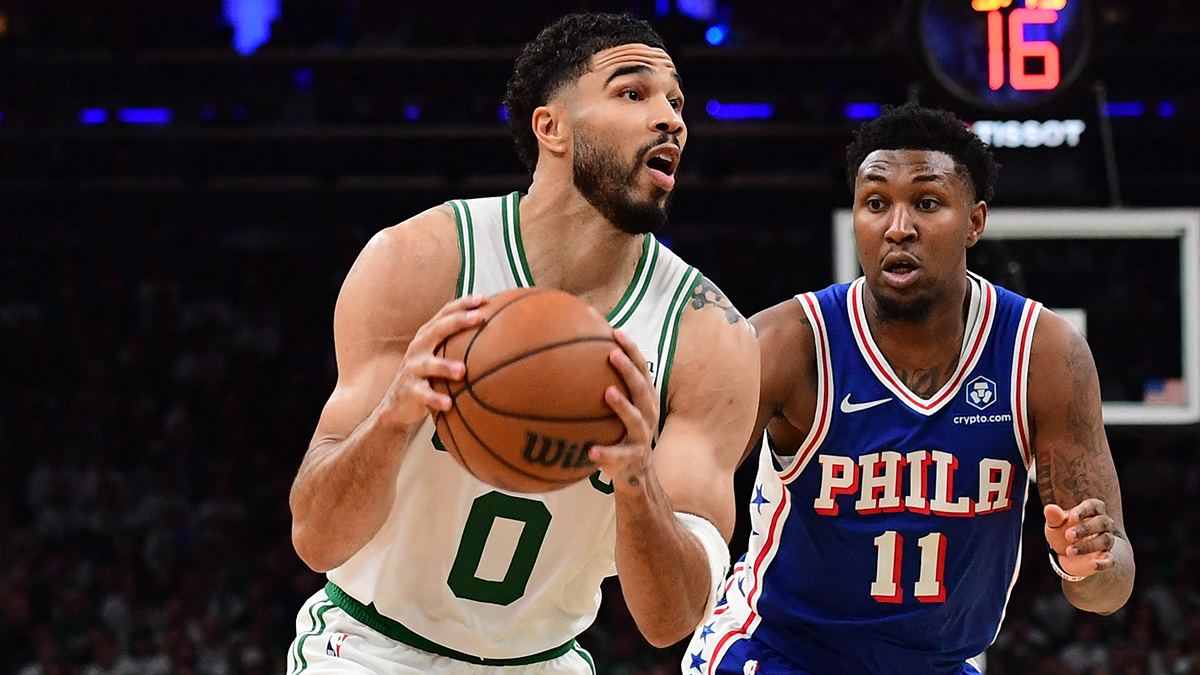

BOSTON — Asked to assess his first playoff game, just 11 months removed from the Achilles rupture that left his future so uncertain, Jayson Tatum basically shrugged off a dominant two-way effort in Game 1 of the Celtics’ Eastern Conference first-round series with the Philadelphia 76ers.
“I’m still rehabbing,” said Tatum, then later added, “Still trying to ramp up.”
If this is “Still Rehabbing” Tatum then … sheesh.
Here are three storylines that stand out from Boston’s dominant Game 1, beginning with Tatum’s all-around prowess:
Two-way menace
Tatum totaled 25 points, 11 rebounds, seven assists and two steals over just 32:25 of game action. He did most of his offensive damage in the first half while helping Boston build a big cushion, then let Jaylen Brown take the offensive baton as the Jays sent a very loud reminder of Boston’s 1-2 championship punch while KOing the Sixers at TD Garden.
Perhaps more encouraging than Tatum’s offensive output was his play on the defensive end. He got switched onto speedy Tyrese Maxey multiple times in the first half but utilized his length to disrupt Philadelphia’s twitchy guard.
The Sixers were a mere 6-of-19 shooting (31.6 percent) when Tatum was the primary defender, per NBA tracking. Maxey finished 1-of-5 shooting with two points when defended by Tatum, with the lone make being a tough finish in traffic around the basket.
Tatum also grabbed 27.5 percent of all defensive rebounds during his floor time as he continues to be the top rebounding forward in the NBA since his return. Boston had a +31.7 net rating during Tatum’s floor time, including a 91.0 defensive rating.
About the only thing that went wrong for Tatum was his 3-point efficiency, as he went 1 for 7 beyond the arc. Connecting on 8 of 10 shots inside the arc helped jolt his overall shooting numbers (9 for 17). Tatum also created 15 assist points in Sunday’s game while committing just one turnover.
Given the way players up and down Boston’s roster answered all the questions about their ability to grow into larger roles during Tatum’s absence, nothing has been more important since Tatum’s return than him working his way back closer to the All-NBA player we saw prior his injury in Round 2 against the Knicks last postseason.
Maybe what Tatum has done over the past 45 days will eventually stop feeling so improbable. You can see the explosion is still working its way back — though it didn’t hinder him from exploding through the 76ers defense multiple times on Sunday.
Tatum is still maybe a slight bit hesitant to dive onto the floor, and understandably so coming back from his injury. But his impact is undeniable, and to think that there’s another level that he might ascend to during these playoffs has to be daunting news for East rivals.
That the Celtics were able to limit Tatum’s workload to start this postseason is a positive as well, even though they’ll need him to maintain his two-way output as Boston gets deeper into this postseason trek.
We’ll just keep saying it: What Tatum is doing at this early juncture simply feels light years ahead of what could have been reasonably expected to this point. And it’s wild to think that, as good as he’s been, there’s another level he might eventually get to.
Live wire
Not all NBA turnovers are equally. A decade ago, after a turnover-plagued playoff loss, then-Celtics coach Brad Stevens told his players he would rather they punt the ball into the stands than give up a live-ball turnover to an opportunistic opponent.
That notion remains a pillar of Boston’s offensive approach. The Celtics didn’t just commit the fewest turnovers in the NBA during the 2025-26 season (1,014 total); they committed 90 fewer live-ball turnovers than the next-closest rival.
Boston led the league while committing just 506 live-ball turnovers, which, for context, was 382 fewer than 30th-ranked Portland.
The Celtics entered Sunday’s Game 1 knowing that the easiest way to activate Philadelphia’s middling offense was to give up easy transition opportunities. The Celtics committed just three live-ball turnovers all game — including one where Nikola Vucevic simply lost the ball going up for a layup — which led to just three points off live-ball turnovers (all by Tyrese Maxey).
All it takes is a couple lazy passes and Maxey can kickstart a lopsided run. Instead, the Celtics made him work against set defenses and rarely let him see ways to get to the basket in a straight line. The Celtics survived 10 live-ball turnovers in the last regular-season meeting against the Sixers but absolutely have to value the ball given the competition they might see along their playoff path.
Boston’s 3.1 assist-to-turnover ratio Sunday was second-best among all Game 1 teams, trailing only Oklahoma City (3.5).
The Sixers’ already anemic offense (96.4 points per 100 possessions) generated just 83.9 points per 100 possessions against a half-court defense. Philadelphia saw 88.8 percent of its plays against a half-court defense, the highest percentage in Game 1s per Cleaning the Glass data.
Vooch’s debut
Nikola Vucevic got the early call in Game 1 when Neemias Queta got in foul trouble in the first quarter. The big question is how Vucevic will hold up defensively, particularly given the various bigs the Celtics might encounter on their playoff path.
In Game 1, NBA tracking had the Sixers shooting 1 for 7 when Vucevic was the primary defender. He had a few instances where his presence around the basket impacted the Sixers, most notably when Dominick Barlow steamrolled at the rim late in the first quarter and Vucevic spilled beyond the baseline taking a hit to contest the layup. Vucevic disrupted a Maxey baseline drive in the second quarter.
One thing the Celtics need to adjust to with Vucevic on the floor: his penchant for wanting to tip rebounds in the direction of teammates rather than always trying to secure them on his own. Boston’s defensive rebound rate was a team-worst 62.5 percent during Vucevic’s floor time.


