


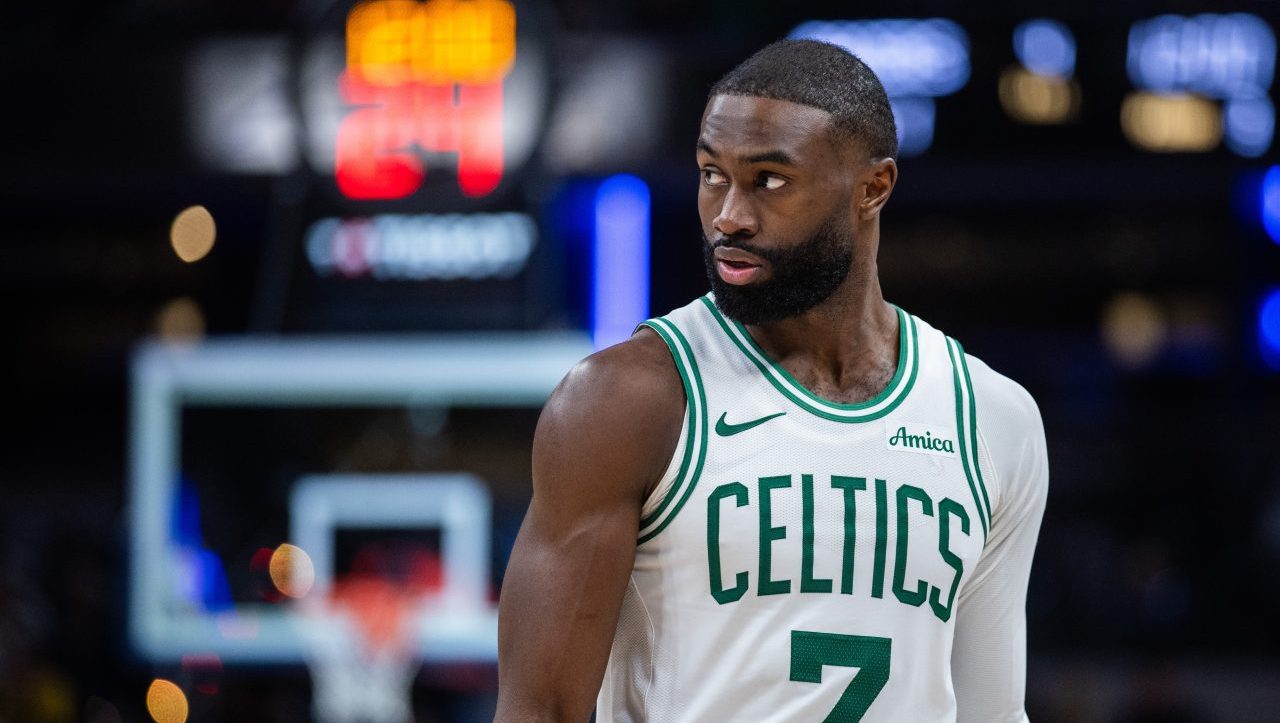
For maybe the first time in league history, the NBA’s annually awkward summer moratorium might have been a good thing. It gave everybody in Boston nearly a full week to process the Jaylen Brown trade.
Celtics president of basketball operations Brad Stevens and lead owner Bill Chisholm will make their first official comments on the trade on Monday afternoon, finally spinning forward a trade that left everyone’s heads spinning. The league’s annual break, an awkward dead zone where trades and signings get negotiated but can’t be finalized over a six-day accounting stretch, gave Celtics fans the opportunity to navigate the entire five-stage grief spectrum.
From the denial that Paul George could truly be the headliner in a Brown package, to maybe the first bit of anger directed at Stevens in his 13 years in Boston, to bargaining whether George is really that much of a dropoff from Brown given his Round 1 performance last season, to the depression that the Jays era is truly over, it feels Boston fans have emerged from the July 4 holiday weekend having finally arrived at acceptance.
We’re guessing most don’t feel any better about the trade itself. But it’s time to move forward.
We’re not certain there’s much Stevens and Chisholm can say Monday about the Brown situation that will make anyone feel much better. They will smother Brown with praise for his decade-long contributions to the organization, including being a monster part of delivering Banner 18. They will likely tiptoe around the circumstances that forced the team to move as quickly as it did at the start of the offseason, especially given the seemingly lukewarm market for Brown’s services.
The best we might hope for is a clearer vision of what comes next.
You can twist yourself into a pretzel trying to determine how we ended up here. The three years, $185 million remaining on Brown’s max-money deal, coupled with the potential for a two-year, $142 million extension later this month, likely left Boston pondering harder if two supermax players commanding 35 percent of the cap was sustainable long-term.
Sprinkle in some analytical debate about Brown’s overall impact on winning, his arrival at his age-30 season, and the perpetual consternation about the 1A/1B stature of him and running mate Jayson Tatum, and it all might have all simmered together to force the Celtics to make a swallow-hard decision on his future.
We’d consider ourselves a numbers guy, leaning heavily into analytics during our time covering the Celtics. We’ve long shrugged our shoulders at Brown’s sometimes unexplainable on/off numbers.
The Celtics owned a +6.4 net rating during Brown’s 2,443 minutes on the court this past season. That’s a strong number and one that stat site Cleaning the Glass says puts the team on the same 56-win pace that Brown ultimately delivered the team. Boston was somehow 5.6 points per 100 possessions better without Brown, per Cleaning the Glass data. There’s some noise in there: lower-leverage minutes with an overachieving bench competing against some lesser competition. But it’s also Brown’s fourth straight season in the negative, including having a minus-8.9 on/off differential in the 2024 title season.
We struggle to reconcile with those numbers. You can’t watch what Brown did in the 2024 Finals, or nearly the entirety of last season, and suggest that he doesn’t impact winning. His greatest strength was his desire to take on challenges on the biggest stage, often producing his best moments when the stakes were the highest or the competition the toughest.
But now, coming off an MVP-caliber season and with Boston pondering the need to reel back in a sky-high usage rate with a healthier Tatum, we understand the consternation that has long existed about how exactly the Tatum/Brown combo might share duties moving forward. That Boston couldn’t immediately put the sort of surefire championship-ready supporting cast around them, this while navigating the new second-apron minefield the new collective bargaining agreement has delivered, added a layer of complication.
So the Celtics made a tough decision to pivot. Unfortunately for them, a very public pursuit of Giannis Antetokounmpo, which might have further forced Boston’s hand, created an expectation for the level of player that might have been obtained in return for Brown.
While there were all sorts of risks with Antetokounmpo, including health and the need to pay him a very hefty long-term contract at an even more advanced age, the idea of pairing two top-10 players was at least intriguing to the Boston fan base. Landing on a past-his-prime George earning his own super max money at age 36 was not the Plan B most expected.
Maybe the Celtics simply felt like it was time to rip the Band-Aid. There was a justifiable fear that, if things didn’t go well this season, Brown’s trade value could have diminished even lower than what Boston seemingly settled for. We refuse to believe that there wasn’t a higher probability that league volatility might have eventually pushed Brown’s value up again, but certainly that was another part of the risk that Stevens and Co. had to ponder.
Maybe the bigger “What if?” is whether the Celtics should have moved off Brown last summer. If the team knew it was going to navigate the so-called gap year the team vehemently pushed back against, then could the Celtics have gotten a bigger haul for Brown (or even Derrick White) and chased a lottery pick while Tatum rehabbed?
The 2025-26 season was such a joy to watch that it feels weird to suggest the team should have embraced a far less enticing path. That said, that route might have expedited the return to true contender status. Hindsight is, of course, 20/20.
Little good can come from lingering on the past. What’s done is done. We’ve had an entire moratorium to process this trade. You don’t have to like it, but this is the path that Boston brass has chosen.
Stevens deserves some benefit of the doubt given his track record. He built a title team in 2023. The last two summers have been incredibly painful with the teardown in the aftermath, but there’s a pathway to a similar roster splurge in the summer of 2027.
The Celtics can reset pesky repeater penalties by staying under the luxury tax again this year. Next summer could provide an opportunity to chase a new star to pair alongside Tatum. There’s a very real pathway to combining the final year of George’s contract with Boston’s growing pile of picks and chasing one of the league’s biggest names.
Of course, we’re not patient around here.
The Celtics will still be competitive this season. George showed in the playoffs that he has something left in the tank, Boston will simply have to be diligent in how quickly they dispense it. There will be an opportunity for Payton Pritchard to step into a bigger spotlight yet again, and White will get every opportunity to show last year was simply an outlier shooting season. Newcomers Mitchell Robinson and Mike Conley can aid in winning.
But all eyes are on the summer of 2027. That’s when Stevens and Co. will have a real chance to show why they made the Jaylen Brown trade.
